
Blockchain Explained: How It Works, from Data to Practical Uses

What Blockchain Actually Is
I've been digging into this topic for a while now. The term gets thrown around a lot, often mixed up with Bitcoin or crypto in general. But blockchain itself is simpler than most explanations make it sound. At its core, it's a digital ledger shared across many computers. Each computer, called a node, keeps a copy. They work together to agree on what gets added. No single server holds the master record. That's the big difference from a bank database or a corporate spreadsheet.
How the Shared Ledger Works
Think of an accounting book that records every transfer of money, every contract, every asset movement. Now imagine that book is copied to thousands of computers around the world. When someone wants to add a new entry, the network checks it against rules everyone agreed on. If it passes, the entry gets locked into a block. That block links to the previous one through a cryptographic hash. Change anything in an old block, and the hash breaks. The next block won't match. The whole chain shows the tampering. This is what people mean when they say the ledger resists changes .

Public, Private, and Permissioned Networks
Not all blockchains are open to everyone. The source material breaks this down cleanly. Public chains like Bitcoin let anyone run a node, send transactions, or help validate. Private chains are run by one organization - a company, a government agency. They decide who participates. Consortium or permissioned chains sit in the middle: a group of known organizations run validators together. Each model trades off decentralization, speed, privacy, and control. A supply chain group might want known validators. A global payment network might want anyone to join. The right choice depends on the problem you're solving.
Network types at a glance
- Public - open participation, high decentralization, lower throughput
- Private - single entity control, faster, less open
- Consortium - multiple organizations, shared governance
Transactions, Blocks, and Nodes
A transaction is just a record of a transfer or change. In a crypto network, it says who sends, who receives, how much, and what asset. The sender signs it with a private key. That signature proves it came from them without revealing the key itself. Transactions sit in a waiting area called the mempool until validators pick them up. They get grouped into a block. Each block carries a hash of the previous block, a timestamp, and a nonce if it's proof of work. Nodes check everything - signatures, balances, rules - before adding the block to their copy of the chain.
The ledger is not merely a collection of copied documents; it is a system in which participants use agreed rules to decide which version is valid.
Why Centralized Ledgers Can Be Changed
In a regular bank setup, your money doesn't go straight to the receiver. It passes through the bank. The bank keeps the records. The bank can edit, reverse, or delete entries under its own rules. That's a single point of control. If someone gets into that system - or if the institution decides to change history - the record changes. Blockchain tries to fix this by making the history independently checkable. Instead of trusting one database, participants verify cryptographic links and follow shared consensus rules.
The main problem with this scheme is that the log of transactions is tamper-able. Entries of transactions can be manipulated easily or change.
Hash Functions - The Glue Between Blocks
A hash function takes any input and spits out a fixed-size code. Same input always gives same output. Tiny change in input - completely different output. Bitcoin uses SHA-256, which produces a 256-bit hash. The source material shows a simple example: "Hello" becomes one hash, "Hallo" becomes a totally different one. Real cryptographic hashes are designed so you can't work backward from the hash to the input. You also can't easily find two different inputs that produce the same hash. This property lets blocks link securely. Each block stores the hash of the previous block. Change an old transaction, its hash changes, the next block's stored hash no longer matches, and the break is visible to everyone.
Public Keys, Private Keys, and Signatures
Your wallet generates a key pair. The private key is like a password - you never share it. The public key is like an account number - you can give it out. They're mathematically linked, but you can't derive the private key from the public one. When you sign a transaction with your private key, anyone with your public key can verify it came from you. The signature changes if the transaction data changes, so tampering is detectable. This is how the network knows you authorized a spend without ever seeing your private key. An address on chain is usually derived from the public key. It doesn't reveal your real identity unless you link it yourself. That's the pseudonymous part.
The Life of a Transaction
Here's the step-by-step from the source. First, you create the transaction in your wallet - pick network, asset, recipient, amount. Second, your wallet signs it with your private key. Third, the signed transaction gets broadcast to peers. Fourth, it lands in the mempool, waiting. Fifth, nodes validate it - check signature, check funds, check rules. Sixth, validators or miners pick it up based on the consensus mechanism. Seventh, it goes into a new block with a hash linking to the previous block. Eighth, the block broadcasts, nodes validate, and add it if valid. Ninth, each new block after yours adds a confirmation. More confirmations mean harder to reverse. Fees pay validators and can speed up inclusion.
Mempools and Double Spending
Double spending is when someone tries to use the same digital coin twice - send it to Alice and also to Bob. Both transactions might hit the mempool at first. But nodes check if the coin is still unspent. Once one transaction gets confirmed and consumes that coin, the other becomes invalid and gets dropped. Traditional payment systems handle this with intermediaries who can reverse things. On a blockchain, finality comes from depth - the more blocks stacked on top, the more work or stake it would take to rewrite history. That's the economic security model.
Consensus - How the Network Agrees
Consensus is the rule set that decides which blocks are valid and which chain to follow. It coordinates who creates the next block, resolves conflicts when two blocks appear at once, and defines when a transaction is final. It also sets the incentives - rewards for honest behavior, penalties or wasted cost for cheating. The two big models are Proof of Work and Proof of Stake. They achieve the same goal - agreement on the ledger - but through very different mechanisms.
Proof of Work - Mining for Blocks
In Proof of Work, miners compete to solve a computational puzzle. They vary a nonce, hash the block, and check if the result meets the network's difficulty target - like starting with a certain number of zeros. The first to find a valid hash gets to propose the block and claim the reward. More computing power means more attempts per second, better odds. But the puzzle is designed so verifying a solution is easy, while finding one is costly. That cost - electricity, specialized hardware, time - is what secures the chain. The source mentions Bitcoin's early block rewards of 50 BTC, then 25, then 6.25 at the time of writing. The reward halves on a schedule. Miners also collect transaction fees. Mining pools let smaller operators combine hash power and split rewards.
Proof of Stake - Staking Instead of Mining
Proof of Stake skips the brute-force computation. Validators lock up - stake - the network's native tokens in a smart contract. The protocol selects validators based on stake size, time staked, and other factors. Selected validators process blocks and earn fees and sometimes new tokens. Ethereum, BNB Chain, Cardano, and Avalanche use PoS. It's generally described as less energy intensive than PoW because there's no continuous mining race. The security comes from the value at stake - validators risk losing their staked tokens if they act dishonestly.
Native Tokens and Network Fees
Every blockchain has its own native token - BTC for Bitcoin, ETH for Ethereum, BNB for BNB Chain, TRX for Tron, MATIC for Polygon. These tokens pay transaction fees, reward validators, and often play a role in consensus security. You need the right token for the network you're using. Sending ETH on the Bitcoin network won't work. Before you transact, your wallet must hold enough of that network's native token for fees. This trips up newcomers sometimes. If you're figuring out setting up a wallet , make sure it supports the network you plan to use.
Why Depth Means Security
Each new block stacked on top of yours is a confirmation. One confirmation means your block is in the chain. Six confirmations means five more blocks have been added after it. To reverse your transaction, an attacker would need to rewrite your block and all blocks after it - and do it faster than the honest network keeps extending the chain. That takes massive hash power in PoW or massive stake in PoS. Confirmation depth doesn't give a mathematical guarantee, but it measures the increasing cost of a reversal. The deeper, the safer.
Decentralization - No Single Point of Failure
If all data lives on one server, that server is a target. Crash it, hack it, seize it - the system goes down or the data changes. In a decentralized blockchain, thousands of nodes hold copies worldwide. Take out a few, the rest keep running. A malicious actor would need to compromise enough independent nodes or control enough consensus power to rewrite history. But decentralization isn't binary. Some nodes are run by big operators. Some participants only run light wallets. Private and consortium chains limit participation on purpose. Public chains are more open but slower and costlier per transaction.
Immutability and Tamper Evidence
Immutability means validated blocks can't normally be changed or deleted. It comes from multiple layers: distributed copies, cryptographic links, consensus rules, and the economic cost of rewriting. If you change a transaction, its hash changes. The block hash changes. The next block's stored hash no longer matches. You'd have to recalculate every subsequent block. In PoW, you'd have to redo the mining work for each. That's why it's called tamper-evident - not mathematically impossible, but practically very hard under normal conditions. Permissioned chains may have admin rules for changes. Public chains can be affected if an attacker gains majority consensus power.
The 51 Percent Attack
This is the classic threat model. In PoW, if one entity controls over half the network's hash rate, they can build a competing chain in secret and eventually overtake the honest chain. In PoS, they'd need over half the staked tokens. With that power, they could exclude recent transactions, double spend, or reorganize history. For major networks like Bitcoin or Ethereum, acquiring that much power costs billions in hardware or staked assets. It gets harder as the network grows. A sustained attack is even harder than a brief one because honest participants keep adding to the real chain.
The 51 percent attack does not by itself reveal private keys or change the rules written into every block. Its principal danger is the ability to reorganize recent history under consensus rules.
Blockchain vs Cryptocurrency
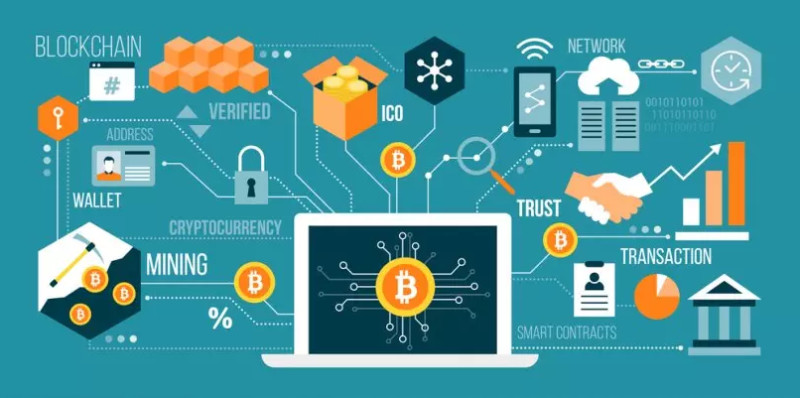
People confuse these constantly. The source cites surveys where most adults thought they were the same thing. Here's the distinction: blockchain is the ledger and validation infrastructure. Cryptocurrency is a digital asset that can run on that infrastructure. Bitcoin is one cryptocurrency. Ethereum supports Ether plus smart contracts and other tokens. You can have a blockchain without a cryptocurrency - like a private supply chain ledger. And you can have a cryptocurrency that doesn't use blockchain, though most do. When someone asks how digital money works , the answer usually involves a blockchain recording transfers without a bank in the middle.
Ethereum and Programmable Blockchains
Bitcoin's blockchain mostly tracks transfers. Ethereum added a virtual machine that runs code - smart contracts. These are programs that execute automatically when conditions are met. No intermediary needed to enforce the terms. This opened the door to tokens representing assets, NFTs for unique digital items, decentralized finance apps, and more. The source mentions tokens for music rights, concert tickets, medical records. NFTs can track authenticity and ownership of digital art, video, music. Programmable blockchains also enable things like peer-to-peer energy trading, decentralized identity, and new organizational structures - sometimes called DAOs. This is where the web3 concept lives - applications built on shared, user-controlled infrastructure instead of corporate servers.
Enterprise and Permissioned Networks
Not everyone wants a public chain. Companies and consortia run private or permissioned networks for shared records where participants are known and vetted. Hyperledger, backed by the Linux Foundation, is a major open-source project for this. IBM and Microsoft offer enterprise blockchain services. These systems give stronger access controls and privacy, higher throughput with fewer validators. The tradeoff: less openness, more governance risk. If a majority of validators collude, they can change rules or history. Public chains avoid this by spreading validation widely, but at the cost of speed and fees.
Real-World Uses Beyond Finance
The source lists a ton of non-financial applications. Tracking food from farm to table. Tracing contaminated products back to the source. Fighting counterfeit medicines. Sharing medical records across providers with patient consent. Land titles and property records. Birth, death, and voting registries. Tokenizing physical assets. Identity and credential verification. Supply chain custody records. Aid disbursement. Intellectual property and royalty tracking. Decentralized data storage. Peer-to-peer energy grids. Government procurement. Vehicle registration. Cybersecurity frameworks. Healthcare stands out because providers often use incompatible systems. A permissioned ledger could give patients control and an audit trail. Governments could use it for land records, identity, elections. Supply chains benefit from a shared, tamper-evident history of every handoff.
Non-financial blockchain applications
- Food safety and supply chain tracing
- Counterfeit drug detection
- Medical record sharing with patient control
- Land titles and property registries
- Identity and credential verification
- Intellectual property and royalty tracking
- Decentralized data storage
- Peer-to-peer energy distribution
When Blockchain Makes Sense
The source frames this well: blockchain is a key for a specific lock, not a master key for every door. It fits when multiple parties need to transact or share data but don't fully trust each other or a central intermediary. Health records, registries, claims, aid distribution, provenance tracking - these are the sweet spots. You need a defined purpose, known participants, shared rules, a consensus method, and a reason a regular shared database won't work. If one trusted party already runs a reliable database, blockchain adds complexity without benefit. The best use cases might not even be invented yet.
The Classroom Analogy - How It Clicks
The source uses a classroom of 30 students to explain the model. First, they imagine a chalkboard the teacher controls - centralized, erasable. Then each student keeps a notebook - but how do they know everyone has the same transactions? The solution: when a student fills a page, they number it, hash the previous page, and distribute it. Others check the handwriting, page number, previous hash, balances, and validity. If it's good, they copy it. Pages are blocks. The linked pages are the blockchain. If two students produce conflicting pages, a rule picks one - in Bitcoin's case, the one with the most proof of work. This illustrates why more confirmations mean more security, why no single participant controls the record, and why anyone can verify.
A Brief History
The timeline in the source starts with the Bitcoin white paper in 2008 under the name Satoshi Nakamoto. First transaction in 2009 between Hal Finney and Nakamoto. 2010: the famous 10,000 BTC pizza purchase. 2011: BTC reaches dollar parity. 2013: Vitalik Buterin publishes the Ethereum white paper. 2014: Ethereum raises $18M in an ICO. 2015: 100,000+ merchants accept BTC. 2016: IBM announces blockchain cloud strategy. 2017: Bitcoin hits $1,000, then nearly $20,000. 2018: Facebook explores blockchain, big banks sign IBM contracts. 2019: China announces a central bank digital currency. 2020: Bitcoin nears $30,000, Bahamas launches a CBDC, blockchain used for COVID research data. The space moves fast, but the core ideas trace back to that 2008 paper.
Privacy, Security, and Access
Public chains are transparent by default - addresses, balances, and transactions are visible. Real identities stay pseudonymous unless linked. Permissioned chains restrict access but introduce administrators and governance dependencies. Security isn't automatic just because you use blockchain. Private key theft, buggy code, compromised endpoints, and social engineering still cause losses. The ledger's tamper resistance doesn't protect the systems and users connected to it. Also, public chains need internet and computer access - people without reliable connectivity get excluded even if the ledger is open in principle.
Performance and Scalability Trade-offs
There's a triangle: decentralization, security, throughput. Public chains maximize the first two but sacrifice speed and cost. Permissioned chains process more transactions with fewer validators but lose openness. Healthcare and government pilots face challenges in scale, access, privacy, and security. The tech is still evolving - most non-financial deployments are small-scale or proof-of-concept. The source notes a 2018 comparison: some blockchain transfers settled in seconds with cents in fees, while ACH took days and wires cost $15+. But those numbers vary wildly by network and load.
Governance and Validator Concentration
Every chain has governance - rules for who validates, how changes are proposed, how conflicts resolve. A chain can be technically decentralized but have validation power concentrated in a few big miners or stakers. Private chains: one org has final say. Consortium: a majority can collude. Public PoW: mining pools may control large hash share. Public PoS: stake distribution determines influence. "Trustless" doesn't mean no trust. It means you trust code, crypto, validators, and incentives instead of a central administrator. Those trust assumptions matter.
Energy Use - PoW vs PoS
Bitcoin's PoW consumes massive electricity - one 2018 estimate put it at 62 terawatt-hours, comparable to a small country. Mining profitability requires latest ASIC hardware and cheap power. Older gear loses money. PoW ties security to energy cost by design. PoS avoids continuous mining computation, so it's far less energy intensive. Validators still run hardware and communicate, but no brute-force hashing race. Permissioned chains use even less. Energy profile varies by network, hardware, and consensus rules. It's a genuine trade-off, not a simple good-or-bad judgment.
Legal and Regulatory Uncertainty
Regulation remains a major barrier. Open networks don't fit neatly into laws built around centralized entities. Custody of digital assets is legally murky. Who's responsible for lost keys? Unauthorized transactions? Smart contract bugs? Fraud? The source cites a 2022 U.S. GAO review finding blockchain could help some applications but didn't resolve most critical challenges and introduced new ones. A Treasury pilot failed because the chosen chain didn't meet NIST crypto standards and lacked legal authority. Few non-financial projects have moved beyond pilots. Adoption brings new admin, technical, and governance requirements.
Benefits and Risks by Network Type
Public networks: broad participation, high decentralization, strong tamper evidence, always open. Downsides: slower finality, limited privacy, higher fees, operational complexity. Private networks: privacy, access control, higher throughput, predictable validators. Downsides: single point of control, less openness, vulnerable to admin or validator compromise. Consortium networks: shared control among orgs, good for inter-org transactions. Security depends on validator count, independence, and collusion risk. Non-financial projects often stall because participants can't agree on data quality, governance, legal authority, or incentives. Blockchain doesn't remove the need for trusted institutions - it shifts where trust lives.
What Trust Actually Means Here
A blockchain ledger doesn't eliminate trust. It replaces trust in a specific intermediary with trust in cryptography, software, consensus rules, validators, and economic incentives. In a permissioned setting, trust is distributed among known organizations. In a public setting, it's spread across many independent nodes. The protocol lets participants verify rules without a central record keeper - compare hashes, validate signatures, check balances, follow the chain with the most accumulated weight. A "trustless" transaction means relying on verifiable protocol rules rather than an intermediary's promise. Blockchain shines where parties need a shared audit trail or value transfer without a conventional middleman. It matters less where one org already controls a trusted database, volume is low, privacy dominates, or governance can't be agreed on.
Policy Ideas from a 2022 Review
A policy review identified four approaches that could help. Consolidate standards so organizations can integrate blockchain with existing systems more easily. Clarify or create regulations for different implementations to reduce uncertainty. Support education so users spot common scams and companies find implementation talent. And let governments use blockchain in their own operations where it solves a specific public problem - helping both public and private sectors learn what works. These aren't mandates, just directions that could reduce friction.

Final Thoughts on Where This Goes
I've laid out the mechanics - hashes, keys, blocks, consensus, network types. The tech is real and it works. But it's not magic. It solves specific coordination problems at the cost of complexity, speed, and sometimes energy. The hype cycle has buried the signal in noise. Most people still confuse the ledger with the assets on it. If you're exploring this space, start with the problem you're trying to solve. Then ask if a shared, tamper-evident ledger with distributed validation actually helps. Sometimes a database is the right tool. Sometimes it's not. And if you're just trying to open an account or buy some coins , you don't need to understand all of this - but it helps to know what you're actually using. The wallet you choose connects you to a network. The exchange or app you use is just an interface. The chain underneath keeps running either way. Same with newer networks - they tweak the consensus, the economics, the governance. But the core pattern stays: distributed ledger, cryptographic links, consensus rules. That's the part that isn't going away.

Comments on “Blockchain Explained: How It Works, from Data to Practical Uses”
No comments yet. Be the first to share your thoughts.