
How to Compare the Best Crypto Exchanges for Safe, Smart Trading
What Is a Crypto Exchange
A crypto currency trading platform is an online place where you can buy, sell, or trade digital assets. Most let you use regular money like dollars or euros to get bitcoin, ether, and hundreds of other coins. Back in the early days, getting crypto meant mining it or finding someone on a forum to swap with. That was slow and technical. Exchanges showed up as a simpler way in.
The first recorded exchange appeared in 2009. Since then, the market has grown into a big space with many venues, each with its own rules, fees, and security approach. The same asset can trade at slightly different prices on different exchanges because each has its own order book and liquidity.
Centralized, Decentralized, and Peer-to-Peer Models
There are three main types. A centralized exchange, or CEX, is run by a company that acts as the middleman. You create an account, verify your identity, deposit funds, and place orders. A 2023 overview estimated about three-quarters of crypto trading happened on CEXs. They're popular because they're easy to use, support fiat, and handle high volume.
A decentralized exchange, or DEX, runs on smart contracts. You connect your own wallet and trade directly from it - no company holds your funds. Early DEXs were clunky and low on liquidity. Then automated market makers (AMMs) changed things. With an AMM, you trade against pools of assets instead of matching with another person. Liquidity providers earn fees. You keep control, but you also handle wallet security, network fees, and contract risks yourself.
Peer-to-peer, or P2P, exchanges let users trade directly with each other. A 2022 overview called them easy to use with wide asset selection, but also the least secure due to scams and weak counterparty controls.
CEXs such as Coinbase or Binance were presented as familiar starting points for beginners because their account and payment processes resemble traditional financial services.
DEXs such as Uniswap or PancakeSwap were presented as noncustodial alternatives for traders who place a higher value on autonomy, direct wallet control, and lower platform fees.
Using both models can give you the convenience of a CEX with the control of a DEX.
Core Features to Check
Before picking an exchange, look at what it actually supports. Here are the main functions:
Key exchange functions
- Administration and operations console
- User authorization and verification (2FA, identity checks, encryption)
- Platform security (encrypted connections, anti-DDoS, breach protection)
- Clear interface for balances, orders, stats
- Wallet custody options (hot, cold, noncustodial)
- Analytics and real-time market data
- Transaction and order history access
- Customer service availability
- Currency range matching your needs
- Research and education tools
- Interest and yield products
- Geographic availability
- API access (public, private, FIX, WebSocket)
Geographic Availability and Legal Restrictions
An exchange must work in your jurisdiction before anything else matters. Platforms restrict service by country, state, or verification level. For example, a 2023 Kraken profile said it served all U.S. states except New York and Washington. Binance.US wasn't available in every state, while Gemini was licensed in all 50.
Trading on an overseas platform might give you more assets, but it may not follow your local laws or offer the same protections. Check licensing, identity rules, restricted assets, withdrawal conditions, and whether you're on the global service or a regional one.
regulated crypto exchangesIf you're in the U.S., looking at cryptocurrency exchanges in the us that are properly licensed can save headaches later.
Coin and Pair Selection
There are over 10,000 digital assets. No exchange lists them all. If you only want bitcoin, ether, and other established coins, prioritize liquidity, uptime, and fees over a huge list. If you chase smaller altcoins, you'll need broader selection - but also check if the exchange follows laws and has safeguards.
Pair counts can be tricky. Two platforms may count differently, and figures from different years aren't comparable. A 2022 overview said Coinbase offered more than 50 coins, while a 2023 profile listed more than 500 crypto-to-crypto pairs.
Fees, Spreads, and Trading Costs
Exchanges charge for deposits, withdrawals, trades, conversions, listings, or API use. A 2023 overview placed typical trading fees between 0% and 5% depending on funding method and transaction type. Many use tiered fees based on 30-day volume - higher volume means lower percentage.
The same overview gave an example: ten separate $1,000 trades in a month might cost $60 on Coinbase, while one $11,000 trade might cost $44. Fee schedule and order behavior matter alongside the headline rate.
Cost categories to watch
- Trading fees - charged on buy/sell
- Deposit fees - adding fiat or crypto (some make fiat free)
- Withdrawal fees - sending funds off the exchange
- Exchange-rate spread - difference between offered price and market price
- Spread and slippage - crossing the order book and execution difference
- Listing fees - for new assets
- API fees - for using the exchange's API
- Borrowing, staking, or yield costs
A low headline rate can be offset by withdrawal charges, deposit costs, wide spreads, or poor execution. Conversely, a higher listed fee can stay competitive at volume if discount tiers are meaningful.
cryptocurrency exchanges with lowest feesDon't just chase the lowest fee number - look at the full picture.
Liquidity and Trading Volume
Liquidity is the ability to buy or sell quickly near the displayed price. Low liquidity means orders wait while the market moves, larger markups, or trouble exiting during sharp drops.
A 2023 guide suggested looking for an established exchange with at least five years of history and high verified volume. CoinMarketCap was named as a place to compare. At that time, Binance, Coinbase, and Kraken were described as volume leaders.
High volume generally means faster fills closer to the displayed price. Thin order books expose you to larger slippage, especially during rapid moves. But volume figures need care - reported numbers differ across providers, and high volume alone doesn't prove safe custody.
A venue with a long record, transparent reserves, independent audits, and clear withdrawal procedures provides additional evidence beyond its headline market share.
Kraken was described as having an audit-verification button showing when an independent audit last checked user balances. Exchanges making big safety claims without supporting disclosures should be compared cautiously with those publishing wallet addresses, audit info, or reserve reports.
Deposit and Withdrawal Options
Before depositing, verify the methods, fees, processing times, and limits:
Withdrawal and deposit checks
- Two-factor authentication for withdrawals
- Withdrawal limits that unlock with identity verification
- Clear rules - no unexplained discretion to block withdrawals
- Multiple funding methods (bank, ACH, cards, digital wallets, crypto)
- Low deposit and withdrawal costs
- Reasonable processing times (1–3 days for bank transfers as example)
- Adequate daily and monthly limits for your account size
- Secure controls (address allowlisting, new-address delays, extra auth)
Also check whether withdrawals work during congestion, maintenance, volatility, identity review, or suspected compromise. Terms on minimum deposits, account limits, and verification levels affect practical usability.
Ease of Use and Customer Support
Ease of use depends on your experience. Beginners may want familiar interfaces, simple payments, clear summaries, and straightforward orders. Experienced traders need advanced charting, order types, conditional orders, margin, derivatives, APIs, and detailed histories.
A platform should make these accessible:
Info that should be easy to find
- Current balances and portfolio value
- Fee schedules by volume level
- Open, filled, canceled, and historical orders
- Deposit status and blockchain transaction IDs
- Withdrawal status and estimated processing time
- Security settings and active sessions
- Support contact methods
- Product restrictions and risk disclosures
Slow support is a real problem when a withdrawal, account lock, or price-sensitive order is stuck. Mobile quality matters too - some apps are complete, others force you to the web for certain functions.
Security and User Protections
Exchanges are prime targets for hacks, phishing, and account takeover. Mt. Gox collapsed in 2014 after losing about $460 million in customer funds - a clear lesson on centralized platform risk.
Account-level protections
Common controls include:
Account security features
- 2FA through authenticator app
- Passkeys and hardware-key support (like YubiKey)
- Withdrawal address allowlisting
- Anti-phishing codes
- Biometric login
- Login and device alerts
- Extra verification for withdrawals, address changes, API keys, freezes
- New-address withdrawal delays
- Stronger protection for high-value transactions
- Biometric and government-ID verification
- Separate auth for account recovery and sensitive changes
Coinbase was described as supporting allowlisting that restricts sends to saved addresses with two-step verification to activate it, plus YubiKey support. Phemex docs required 2FA for withdrawals and new addresses, plus passkeys, anti-phishing codes, and allowlists.
Custody and platform protections
Platform-level security covers how assets and keys are stored:
Custody signals
- Most user assets offline in cold storage
- Limited hot-wallet balance for active trading
- Multi-signature controls
- Segregation of customer assets
- Encryption at rest and in transit
- Controlled admin access
- Physical security
- Monitoring and anomaly detection
- Documented incident response
- Ongoing penetration testing
- Independent audits
- Bug-bounty programs
- Public security documentation
Cold storage keeps keys offline. Hot wallets support deposits and trading but have a larger attack surface. The balance between them is part of a broader custody architecture. A 2022 Coinbase profile said it stored up to 97% of bitcoin in encrypted, geographically separated offline facilities and insured the hot-storage remainder. Crypto.com cited cold storage, theft insurance up to $360 million, multi-factor auth, biometrics, anti-phishing, and external hacking attempts to find weaknesses.
Proof of reserves and transparency
Proof-of-reserves tools verify an exchange holds assets matching reported liabilities. Other signals: public wallet addresses, on-chain verification, reserve reports, methodology explanations, independent audits, clear details on who controls customer funds.
A 2026 security comparison described Phemex as providing 24/7 proof-of-reserves and proof-of-liabilities, a dedicated guide, and public cold-wallet addresses. Kraken emphasized proof of reserves in its security material.
Reserves and audits address different questions. A user should examine the date, scope, assets covered, liabilities included, independent-party role, and on-chain evidence behind any report.
Certifications and compliance
ISO 27001, SOC exams, licensing, regulated custodianship, and formal compliance programs can signal trust when backed by operational controls. But certifications don't guarantee no breach or fraud.
The 2026 comparison said Kraken was ISO/IEC 27001:2022 certified and completed SOC 2 Type 1. Gemini emphasized SOC-related certification and a security-first compliance narrative. A 2023 profile described Gemini as SOC 2-certified with insured user funds.
Insurance and funds protection
Some exchanges say customer funds are insured against hacking or theft. Coverage may apply only to certain custody arrangements, exclude some assets or events, and have limits. Fiat deposits may get different government protections than crypto. Coinbase's 2023 profile referenced platform insurance and FDIC coverage for eligible U.S. dollar balances.
User responsibilities
Platform controls only help if you enable and use them. Common mistakes:
Security mistakes to avoid
- Treating a large exchange as automatically safe
- Leaving 2FA disabled
- Not using withdrawal allowlisting
- Ignoring passkeys, security keys, or anti-phishing tools
- Relying only on a certification without enabling practical protections
- Picking a platform unavailable in your jurisdiction
- Keeping large balances without reviewing custody architecture
- Not reviewing login and device alerts
- Using a service without checking withdrawal rules and address controls
The strongest exchange for a security-first beginner is the one whose protections you can understand, enable, and maintain.
safest cryptocurrency trading platformThere's no single safest option for everyone - it depends on what you can actually use.
Execution Quality and Best-Price Handling
A 2026 execution review described best execution as more than connecting to an exchange and taking the top of the order book. The question is whether the client got the best available price and whether the result can be measured against a credible reference.
Regulatory direction
The EU's Markets in Crypto-Assets Regulation requires Crypto Asset Service Providers to take all sufficient steps for best execution. In the U.S., FINRA best execution is an evergreen priority, and the SEC has proposed Regulation Best Execution. The institutional question shifted from whether a provider can connect to liquidity to whether it can prove the best price was received and show how it was measured.
Fragmented crypto liquidity
Traditional equities have consolidated tapes and a National Best Bid and Offer. Crypto doesn't. Price discovery happens across exchanges, OTC desks, market makers, and other venues - each with different depth, fees, participants, and latency.
This fragmentation makes the benchmark choice important. Benchmarking against the same exchange's internal price grades the system against itself. Using one exchange as reference ties results to that venue's conditions rather than the broader market.
The review described working with customers to set a benchmark - typically an aggregated midpoint from several exchanges - and sourcing prices through independent third-party feeds rather than the firm's own order flow to prevent bias.
Execution metrics
Measures identified for institutional and compliance use:
Execution quality metrics
- Slippage against arrival midpoint
- Slippage across different order sizes
- Fill rate
- Effective spread
- Market conditions at order arrival vs execution
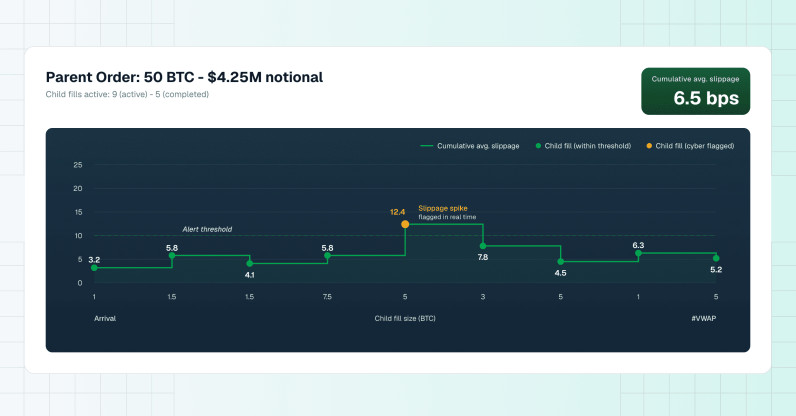
- Real-time slippage across child fills of a large parent order
- Full audit trail of decisions and trades
A $10,000 order and a $1 million order operate in different liquidity environments. Measuring both under the same standard reveals where depth becomes insufficient. Large parent orders face changing conditions during execution - first-fill quality doesn't describe the complete order.
Using execution data to improve routing
Execution analytics feed back into routing decisions. A pattern of higher slippage above a certain size for one asset can inform how the next order is allocated. Time windows where liquidity thins can be incorporated into routing logic.
The feedback loop: measure fills against an independent multi-venue benchmark, identify patterns by asset/size/time/venue/conditions, change routing allocations, measure next orders, refine with more flow.
Monitoring liquidity providers
A router only uses the liquidity supplied to it. Monitoring tracks:
Provider monitoring points
- Fill and rejection rates per provider
- Depth contributed at different price levels
- Quote-update speed after market moves
- Volume concentration across providers
- Stale or withdrawn quotes
- Provider performance in specific assets and conditions
Thin depth from a single provider creates concentration risk. Stale quotes degrade execution even with good routing logic. Monitoring also protects providers by catching deteriorating quotes before they cause poor fills.
Exchange APIs and Integration Capabilities
API means Application Programming Interface. It's how an exchange and other systems request and exchange data - prices, orders, wallets, payments, identity, live market info.
For an operator, APIs connect pricing, trading, wallets, payments, charts, identity, and liquidity. For a trader, API access determines whether an exchange supports automated strategies, bots, advanced orders, or external portfolio tools.
Public, private, and operational API categories
API types
- Public APIs - general market info (prices, volume, changes), often no account needed
- Private APIs - account-specific actions (orders, balances, history, transfers), need secure auth
- Partner APIs - connect exchange with liquidity providers, payment processors, custodians
- Composite APIs - combine several requests into one response (wallet info, live prices, open orders)
- Internal APIs - connect exchange's own components (admin, KYC, analytics, backend), not for public use
Key API capabilities to evaluate
API capabilities checklist
- Price ticker API - current prices for displays and dashboards; delayed data causes stale decisions
- Wallet API - manages and updates crypto balances automatically
- Historical data API - past prices for trend analysis, backtesting, charting, research
- Trading bot API - encode rules and automate orders without manual action
- REST API - GET, POST, PUT, PATCH, DELETE for balances, orders, records
- WebSocket API - open connection pushing live prices, order-book changes, trades, account events
- Payment API - connects wallets, exchanges, payment systems for transfers, conversion, settlement
- Merchant API - lets businesses accept/verify crypto payments, convert to local currency
- Liquidity API - connects venue with other exchanges or pools for better pricing and depth
- KYC API - verifies identity, checks documents, activates accounts
- Streams API - one-way live data from server (prices, trades, order books, dashboards)
Selecting an exchange API
An integration guide gives six criteria:
API selection criteria
- Define the goal: trading, payments, merchant, liquidity, wallets, or other
- Review documentation - current, clear, complete, usable during implementation
- Test response speed - slow APIs delay prices, orders, balances, payments
- Evaluate security - encryption, auth, permissions, secure login
- Plan for scalability - handle future user and traffic growth
- Check support and updates - technical assistance and regular improvements
A 2023 guide also identified public/private APIs, FIX protocols, and WebSockets as integration methods improving connectivity. Trusted API integrations link to faster development, real-time data, better security, improved UX, multiple integrations, scalability, cost efficiency, automation, reliability, and faster time to market.

Multi-Exchange Management
Managing assets across several exchanges means repeatedly checking balances, fees, transactions, and orders. Bitsgap's multi-exchange service was described as controlling more than 15 connected accounts through one interface using encrypted API keys. It shows connected balances, fees, and transactions in a single dashboard.
Tools included a TradingView interface with charting, smart orders (trailing, hedging), automated spot and futures bots, and GRID, DCA, BTD, and COMBO strategies. A multi-exchange interface reduces manual switching, though security still depends on API permissions, key protection, and each exchange's practices.
Wallet-Based Swaps
MyEtherWallet guidance emphasizes reviewing beginner tips before swapping ether and tokens to avoid mistakes and get better value. MEW describes itself as an open-source Ethereum wallet for creating wallets and buying, selling, staking, and swapping digital assets.
A 2022 Five-Exchange Snapshot
A Twine overview from March 2022 categorized Coinbase as best overall and most reliable bitcoin exchange, Binance.US as best for beginners, Gemini as best for experienced traders, Kraken as suitable for both, and Crypto.com as best for security. These were dated labels, not a universal ranking.
The overview defined a crypto exchange as an online platform for buying, selling, or trading crypto with fiat. Uses included investing in new token offerings, trading NFTs, and secure storage.
Coinbase in the 2022 overview
Described as using 2FA and cold storage, storing up to 97% of bitcoin in encrypted, geographically separated offline facilities, insuring the remaining 3% in hot storage. User-friendly, 50+ coins, high volume and liquidity.
Binance.US in the 2022 overview
Binance was the world's largest by volume. Binance.US was a separate platform for U.S. compliance. Praised for usability, fees, liquidity, broad selection. Placed below Coinbase on reliability, not available in every state.
Gemini in the 2022 overview
Secure, liquid exchange for experienced traders. Market/limit orders, charting, forecasting, data analysis. Mobile-ready, all 50 states. Fewer coins than Coinbase, higher costs for low-volume trades.
Kraken in the 2022 overview
Suitable for beginners and experienced traders - easy interface plus advanced tools. 56 coins, ~$1B volume, no deposit fee, low instant-trading fees. Above-average instant fees on some transactions, withdrawal fees, high minimum deposits.
Crypto.com in the 2022 overview
Low-fee platform for crypto payments, interest, rewards Visa card. Interface and support rated less favorably. Security: multi-factor auth, biometrics, anti-phishing, external testing, cold storage, theft insurance up to $360 million.
The 2022 guidance said a buyer interested only in bitcoin and ether could prioritize uptime, liquidity, and fees. An altcoin buyer would weight asset breadth more. Security, geographic availability, ease of use, deposit/withdrawal options, volume, spreads, and API fees were all decision criteria.
Centralized Exchange Profiles from 2023
A June 2023 guide evaluated exchanges on security, offerings, accessibility, fees, financial options, features, and mobile. Figures and availability were specific to that date.
Coinbase
Founded 2012 in San Francisco, publicly traded, 100+ countries, $14B+ valuation at the time. 500+ crypto-to-crypto pairs, major and smaller-cap assets, wire and ACH funding, multiple deposit/withdrawal options. Custodial on Coinbase.com, self-custody via Coinbase Wallet. Interface for first-time buyers and pros. Insurance for platform funds, FDIC for eligible dollar balances. Fees 0–0.6% by volume. Complaints about customer service, sudden account closures, some listing decisions.
Kraken
Operating since 2011, strong reputation with pros. Two interfaces: Kraken (casual, instant-buy fees up to 1.5%) and Kraken Pro (customizable, charting, order books, margin, derivatives). Pro fees starting at 0.16% maker / 0.26% taker, falling to 0% / 0.10% for high volume. Broad assets, high liquidity, competitive pro fees, advanced tools, security/compliance reputation. Not hacked as of that date. Licensing, customer-fund protection, major and smaller-cap assets. High fees on basic platform, funding varies by verification and country. Available in all U.S. states except NY and WA at the time.
kraken trading platform reviewIf you're reading a Kraken review , note the two-tier interface - basic and Pro - with very different fee structures.
Binance
Largest global exchange, most countries, 500+ cryptocurrencies, advanced features. Binance.US separate with 150+ coins under tighter U.S. rules. Global strengths: 500+ coins, many fiat pairs, low fees (especially with BNB), spot/margin/P2P/futures/options/NFT, multiple order types, Binance Academy education. Cited: complex interface, steep learning curve, no built-in wallet per the 2023 profile, limited withdrawal support, regulatory restrictions/bans in several countries, money laundering allegations, continuing U.S. investigations. Global Binance offered more than Binance.US, frustrating American users.
Crypto.com
Founded 2016, 90 countries, 250+ cryptocurrencies, native token ecosystem. Mobile app as major strength with web-comparable functions. 250+ coins, mobile trading/earning/managing, Crypto Visa card, fees up to 0.075% falling to 0% for high volume, borrowing/lending, 24/7 mobile access. Weaknesses: slow/unhelpful support, app-dependent for full range, controversy around 2020 MCO-to-CRO swap. CRO value tied to platform success.
Gemini
Founded 2014 by Winklevoss twins. NY-focused, security/compliance emphasis, insured funds, SOC 2 certification. Strengths: security/compliance, licenses in all 50 states, high liquidity 24/7 in major coins, insurance for insured hot wallet funds, advanced platform for pros. Disadvantages: fees up to 1.49%, 100+ coins only, abrupt account closure controversy. Gemini Dollar stablecoin value tied to platform - additional risk if Gemini struggles.
best cryptocurrency exchange in us best crypto exchange for usFor U.S. traders, the top U.S. option depends on whether you prioritize asset count, fees, or compliance - there's no single best choice for everyone .
Decentralized Exchange Profiles from 2023
Uniswap
Leading Ethereum-based DEX, daily volume in billions. Support for numerous ERC-20 tokens, Polygon swaps, bridges with Optimism and Arbitrum to reduce gas. 600+ assets. Strengths: broad ERC-20 selection, simple wallet-connect interface, no signup or personal info, earn fees supplying liquidity, large liquidity depth, compatible with major Ethereum wallets. Disadvantages: no direct fiat purchases, potentially high Ethereum gas fees, impermanent-loss exposure, no current APR info in interface. No KYC supports privacy but creates regulatory uncertainty. SEC was investigating at the time.
PancakeSwap
DEX on Binance Smart Chain for BEP-20 tokens. Ecosystem: CAKE token, yield farming, lottery, initial farm offerings, NFTs, staking, lending. V3 with liquidity improvements. Strengths: trading and yield across BEP-20 tokens, simple wallet connection, 0.25% stated fee, liquidity comparable to large CEX, yield opportunities stated up to 100% APY, compatible with BSC wallets. Limitations: BEP-20 only (no direct bitcoin/ether), no fiat on-ramp, must acquire BNB/BSC assets elsewhere. Web-based, no mobile app or official support team. Prediction market info could lag. Impermanent loss remains, especially with volatile pairs.
Upbit's GIWA Chain and Exchange-Owned Infrastructure
A May 2026 report described South Korean exchange Upbit (operated by Dunamu) planning GIWA Chain, an Ethereum Layer-2 built with Optimism's OP Stack. Testnet live, mainnet planned. First network on the self-managed tier of OP Enterprise. Upbit would operate the primary sequencer and control chain config. Optimism Foundation provides monitoring, engineering support, backup sequencer. Compared to Coinbase's Base and Kraken's Ink using OP Stack.
Upbit described as South Korea's largest crypto exchange. Reuters cited ~70% domestic market share in late 2025. Dunamu valued at ~$10.2B in Naver Financial's planned acquisition. CoinGecko placed Upbit at 6.7% of CEX spot volume among top exchanges in 2024 (8.5% in 2023, 6.9% in 2022, 12.2% in 2021). A 2025 report placed it at 5.5% market share among top ten, volume down 18.9% year over year.
The GIWA Chain plan shows how a large exchange can operate dedicated blockchain infrastructure, control its sequencer, and rely on an external foundation for monitoring and backup.
A 2026 Security-First Exchange Comparison
A Phemex Academy comparison updated March 2026 evaluated security separately from fees, product count, and volume. Framework ranked Phemex as best overall security globally, Kraken strong for institutional-style documentation, Coinbase/Coinbase Advanced strong for U.S. retail, Gemini strong for compliance and audit signals. Binance included for users already in its ecosystem willing to manage settings carefully. No single exchange called universally safest - conclusion depended on region, custody preferences, trading activity, and whether users enabled protections.
Security ranking criteria
Five security categories
- Account features (2FA, passkeys, security keys, allowlisting, anti-phishing)
- Custody and platform-security disclosures
- Proof-of-reserves, proof-of-liabilities, security documentation
- Certifications, audits, compliance trust signals
- Security education and ease of using protections
Phemex
Ranked first for account controls and verification: 2FA required for withdrawals and new addresses, passkeys, withdrawal allowlisting, anti-phishing codes, additional delays for new whitelist addresses, 24/7 proof-of-reserves and liabilities, public cold-wallet addresses, dedicated security guide. Possible difficulty accessing for some U.S. residents.
Kraken
Strong in security-documentation depth and infrastructure: cold/hot wallet architecture, physical protections, encryption at rest, controlled access, ongoing testing, proof-of-reserves content, ISO 27001:2022, SOC 2 Type 1. Reuters-reported March 2026: Kraken's banking arm secured a limited-purpose Federal Reserve payments account (institutional trust context, not direct exchange security feature). Trade-off: security-heavy platform and detailed controls may exceed beginner needs.
Coinbase and Coinbase Advanced
Practical security for U.S. retail: address allowlisting with two-step verification, 2FA, biometrics, login/security guidance, YubiKey support via ecosystem. Coinbase Advanced adds stronger trading tools while keeping account controls. Warning: features only help when enabled with good device security, phishing awareness, recovery planning.
Gemini
Compliance- and audit-oriented: "trust is our product" messaging, SOC-related certification claims for exchange and custodian operations. Earlier material documented SOC 2 milestones. Certification and trust branding should be weighed alongside account controls, custody practices, and product fit.
Binance
Included for size, ecosystem, extensive documentation. Large platform provides many tools but more settings and complexity increase importance of correct configuration. Ranked below the other four under this framework because they presented more directly visible security-focused narratives. Trade-off: greater dependence on user discipline across a complex ecosystem.
Security profiles at a glance
Quick security summary
- Phemex: Best overall global profile; 2FA for key actions, passkeys, allowlisting, anti-phishing, strong reserves/liabilities emphasis, growing docs. Possible U.S. access issues.
- Kraken: Deep disclosures, cold/hot controls, proof-of-reserves, ISO 27001:2022, SOC 2 Type 1. More controls/complexity than some beginners need.
- Coinbase/Coinbase Advanced: Mainstream retail protections, allowlisting, two-step verification, YubiKey, strong help center. Results depend heavily on setup.
- Gemini: Compliance-forward, security docs, SOC certification claims. Practical fit still needs assessment.
- Binance: Large global ecosystem, broad docs. Complexity increases importance of disciplined user-side security.
Security choices by user profile
For a security-first beginner: easy 2FA, clear anti-phishing guidance, withdrawal allowlisting, simple security menu. Protection that's hard to enable is less useful than a simpler feature you actually maintain.
For large balances on an exchange: custody disclosures, proof-of-reserves transparency, hardware-key support, login/device monitoring, recovery processes. Kraken, Gemini, Coinbase, and Phemex each worth comparing for different combinations.
For frequent traders needing security and convenience: reliable login/security-key support, configurable withdrawal protections, clear alerts, account-activity visibility without workflow interruption.
For users prioritizing verifiability and transparency: proof-of-reserves docs, proof-of-liabilities where offered, public verification resources, detailed security help pages.
Security features, availability, and docs change. Check current official security and help pages before deciding. Digital-asset prices can be volatile - you may lose some or all invested value. Products may be unavailable in your region.
Final Thoughts on Picking an Exchange
Choosing an exchange isn't guesswork. Match the venue to how you actually trade. If you're just starting, a CEX with familiar flows and fiat on-ramps makes sense. If you value control and don't mind handling your own wallet, a DEX fits. Many people use both.
Check the basics first: is it available where you live? Does it list the assets you want? Are the full costs (fees, spreads, withdrawal charges) reasonable for your volume? Is liquidity enough for your order sizes? Can you deposit and withdraw the way you need? Is the interface right for your experience level? Does support respond when things go wrong?
Then layer on security: what protections exist, which ones can you actually use, and does the custody model match your risk tolerance? Look for proof of reserves, audit transparency, and certifications backed by real controls. Enable every protection the platform offers - they only work if you turn them on.
If you're building something, the API layer matters. Public data, private account actions, WebSocket streams, liquidity connections - pick an exchange whose API docs are current, whose response times are solid, and whose security model fits your integration.
trading platforms for crypto what are the best crypto trading platformsThere's no universal answer to which platform wins . The right trading platform for crypto is the one that fits your jurisdiction, your assets, your volume, your technical comfort, and your security habits. Do the homework once, then trade with confidence.
Comments on “How to Compare the Best Crypto Exchanges for Safe, Smart Trading”
No comments yet. Be the first to share your thoughts.