
How Credit Card Cryptography Protects Your Payments and How to Get It Done Without Pain
What Credit Card Cryptography Means
If you swipe or tap a card, you, probably, already wondered: how my data stays safe? Credit card cryptography is the math lock that keeps payment data unreadable to attackers. I like to think of it as a secret code that only the right key can open. As sources say, encryption scrambles data into a format that nobody can read without the proper key. This shields not just card numbers but also names, dates, and codes.
If criminals intercept the transmission or break into storage, they see nonsense symbols. That matters because without strong credit card cryptography, users risk identity theft and fraud. Peace of mind for online buys comes from this protection. Some folks look for a card that feeds you crypto back but the same base locks apply to those too. The big card networks move a massive amount of money, so the need to keep payments safe grows right along with use. Encryption gives customers a reason to trust software with their financial details.
Encryption safeguards information, scrambling data into an unreadable format decodable only with the proper key.
People like to encrypt all kinds of things, and that is their own business. Modern crypto usually does not care about the type of data. If you can encode it as a file, standard methods can encrypt it. You rarely need a special domain-specific algorithm. The card number case is one where the shape of the data really does matter, and that is what makes credit card cryptography a neat niche to study.
How Basic Encryption Keeps Card Data Safe
There are two main kinds of keys in this game. Public keys are shared and used to encrypt. Private keys stay secret and decrypt. This asymmetrical method means even if a public key is grabbed, data stays safe without the matching private key. When encrypting, the data goes through a scrambling dictated by an algorithm such as AES or RSA.
Symmetric encryption uses one key for both jobs. AES is a common standard. It works in rounds of math transforms on blocks of 128 bits, with key sizes of 128, 192, or 256 bits. RSA is the older asymmetric algo based on hard math of factoring big primes. Both are core to credit card cryptography today. The design of AES means tiny changes in input cause big changes in output, which helps resist attacks.
Simple rules for data at rest
- Use AES unless you need compatibility with another app.
- Pick a 256 bit key unless a weaker one is needed for old systems.
- Avoid ECB mode if you can; it shows patterns in your data.
- Use CBC mode for short data like card numbers, most secure is AES/CBC/PKCS5Padding.
For passwords, use SCrypt or BCrypt if you can. If not, SHA-512 with many iterations and a salt per password. Consider a pepper before hashing for extra protection. Don't use weak old stuff like MD5 or SHA1. I remind you, these steps sit under the big tent of credit card cryptography even if they are for logins. Good key choice is the first wall of defense.
Public keys are freely circulated and employed for encryption, whereas private keys are retained secretly and employed for decryption.
For larger data like documents, CTR or GCM modes balance speed and security. Generate your own IV when possible for better compatibility. The math behind these algorithms is solid, but the way we handle keys is where real world mistakes happen. That is why the rest of this post looks at cards specifically.
Why Card Numbers Need Special Care
A card number is just a number, but it has length limits. A 16 digit Visa can be seen as an integer up to 9,999,999,999,999,999. In binary that needs about 54 bits. If we encrypt with a stream cipher and no padding, we get a 54-bit string. Not bad at all in theory.
But here is the rub: many old retail systems only accept standard 16 digit decimal numbers. If your software can't handle a 54-bit string, you must translate the cipher back to something that looks like a card number. The naive solution fails because a uniform 54-bit string can map to too many digits. Also you might need to search a database for a card number, which calls for deterministic encryption that always maps the same input to the same output.
Some people want a a crypto wallet bolted to a card style setup, but the formatting problem is the same. The math must keep the shape of the data. Using ECB mode with AES would give a 128-bit block, far too long to squeeze into 16 digits. This is where format-preserving encryption becomes a friend. The trick is to make the cipher work on the exact set of possible card numbers.
The global network brand cards such as Visa, UnionPay, Mastercard, American Express, JCB and Discover generated huge purchase volume worldwide. As such, card payments trend is only expected to grow further and the need to keep payments secure grows with it. Credit card cryptography that respects legacy formats is not a luxury, it is a practical must for many merchants.
Format-Preserving Encryption Steps In
The answer to the format problem is called Format-Preserving Encryption, or FPE. The name says it: encrypt safely while keeping the original format. So a 16-digit card number encrypts to a 16-digit number. No weird length changes that break old systems.
Back in 2002, Black and Rogaway wrote the key paper on this. They made three plain observations. First, lots of apps need to preserve input format. Second, designing your own cipher would probably suck. Third, it would be nice to do it with standard ciphers like AES. And they found a way using Feistel networks, which had been studied by Luby and Rackoff earlier.
What Black and Rogaway noted
- There are apps where you must keep the format of input data.
- Designing a custom cipher is likely a bad idea.
- Using standard ciphers like AES would be best.
- They showed you can build ciphers of arbitrary block size with Feistel constructions.
The Feistel idea splits the input into two halves and pushes them through rounds with XOR and a non-linear function F, often implemented via AES. Since AES is strong, only three or four rounds are needed. Later work in 2009 added the idea of a tweakable block cipher to fight dictionary attacks on small domains. Adding extra data like the BIN or expiry as a tweak makes attacks much harder. Standards bodies picked this up for FPE. This whole field is a branch of credit card cryptography that saves merchants pain.
Format-Preserving Encryption, or FPE, securely encrypts while preserving the original formatting of the plaintext data.
Bellare, Ristenpart, Rogaway and Stegers wrote that 2009 paper formally defining FPE and security goals. The tweak concept significantly enhances security when encrypting small domains. NIST proposed an FPE standard with constructions like FFX-radix and VAES. There is also work in the ANSI X9 committee to create a financial industry standard. That shows the topic is live and practical.
The Cycling Trick For Card Numbers
One neat method from those researchers is called cycling. It is so simple you'd think it can't work, but it does. Say I want to encrypt my Visa number 4532294977918448. I encode it as a 54-bit integer and encrypt with the built cipher from the Feistel approach.
If the result is small enough to fit in 16 digits, done. If not, just encrypt again and check. Repeat until it fits. Since the cipher acts random, there is about a 55 percent chance each pass, so you rarely need more than a couple tries. This costs nothing in security in the ideal case, which Black and Rogaway proved.
But real card numbers aren't fully random. They have a Bank ID Number, an account number, and a checksum digit. If the account part is short, an attacker with an encryption oracle could brute force all options in a day at 1000 tries per second. The tweak idea fixes that by expanding the dictionary. Still, cycling shows the clever side of credit card cryptography and how a simple loop can solve a format headache.

Another neat thing is that cycling does not expand the ciphertext size. You end up with a number that fits the old field. For a merchant with a legacy retail system, that means they can store encrypted cards without rebuilding the database. The math is old but still useful.
Smart Chip Cards And Their Crypto
Chip cards changed the game. The secret number sits in the chip and can't be cloned easily. The chip does crypto ops to prove itself without revealing the secret. The exact math depends on the bank, but two models show up in practice under the ISO 7816 standard.
Two common chip card models
- Card does symmetric crypto only, with a static ID signed by issuer and a secret for MAC.
- Card can compute digital signatures with a private key unknown even to the bank.
- PIN sent to chip convinces it the owner is present.
- Asymmetric cards cost more but give offline proof of genuineness.
In the first model, the bank holds a copy of the secret, so it could fake a transaction in theory. In the second, only the card knows the private key, which helps in legal fights between bank and customer. Historically in France, all cards followed the first model, and terminals allowed offline only for small amounts. Later wireless links made online checks common. The price gap between card types has shrunk, but the market moves slow because cards must expire.
The chip based cards can not be cloned as the secret number is embedded in the chip and protected by the use of public key cryptography.
Around 2000, a French engineer factored a weak 320-bit RSA modulus used in bank signatures and made a fake card. He tried to sell the info and got arrested. That mess showed how bad a short key is. Good credit card cryptography needs keys long enough to resist such math. The chip performs a digital signature over transaction details, and the reader can prove the card was present without ever seeing the private key.
Old SSL Is Gone, Use TLS
SSL was the old protocol for safe web traffic. It is now broken with flaws like Heartbleed. The PCI council said SSL is not acceptable for strong cryptography. Merchants must move to TLS, the successor protocol that defines how encryption is implemented between browser and server.
Think of TLS as the evolved version of SSL. For card-not-present sales, disable SSL and set servers to the modern TLS version. If you outsource hosting, make sure the vendor does this. Card-present merchants must check their point-of-sale software doesn't use SSL. Your certificates are just files with key and ID info; the protocol defines the rules for the conversation.
When a customer starts a checkout, TLS encrypts their card data before it crosses the net. This is a front-line part of credit card cryptography for web shops. Some may search for a painless way to buy crypto options but the same transport rules protect those pages too. The PCI council also pushed updates to the data security standard to reflect this shift, and merchants get a period to comply.
Nothing happens to certificates unless you think you were hit by an SSL exploit. The key point is that the tunnel must be strong. A weak transport layer throws away all the good work done by encryption at rest. I always check for the lock icon before typing my number.
Cloud Services For Payment Keys
Managing keys at scale is hard. Cloud services like AWS Payment Cryptography offer payment HSMs that handle PIN and security code generation. They simplify the heavy lifting of key management for payment processing apps that must decrypt, transform, and encrypt at each step.
Instead of buying on-site HSMs and doing paper key ceremonies with couriers, you can use elastic cloud tools. They follow PCI standards such as PCI DSS, PCI PIN, and PCI P2PE. You can import export keys with protocols like ANSI X9 TR-31 and TR-34. Apps call the service via normal SDKs in Java or Python rather than odd vendor interfaces.
What cloud payment crypto can do
- Encrypt and decrypt card data with payment HSMs approved to PCI PTS.
- Create and manage symmetric keys without paper rituals.
- Support point-to-point encryption and PIN translation between key sets.
- Validate chip card cryptograms and card verification values for issuers.
Acquirers use it for decrypting terminal data and MAC generation. Issuers use it for PIN verification and card validation. A follow-up post on simplifying payment flows describes these acquirer and issuer cases in detail. This is practical credit card cryptography without pain, letting small teams avoid building a secure room. You pay per active key and API call, which beats a hardware closet.
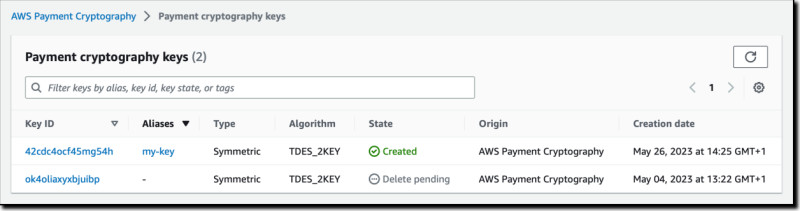
For example, you can create a double-length 3DES key as a card verification key using a command line. Then generate a CVV2 for a test number and verify it. The service logs via standard monitoring tools. This shows how the dry math turns into clickable steps for real payment flows.
Key Management And Storage Rules
Good key administration is the backbone. Keys must be made, stored, and shared safely. PCI DSS sets the rules for card data security. Compliance is not just legal; it shows you care about customer data. GDPR and CCPA also push encryption as a baseline.
Key safety basics
- Never store keys with the data they protect unless wrapped by a KEK.
- Never put secrets in code; leaks from public repos happen a lot.
- Use an HSM or cloud vault for storage if possible.
- Don't store card numbers, even encrypted, unless you truly need to.
Access control limits who sees card data. Use role-based access and multifactor auth. Regular pentests find holes. Rolling your own credit card processing is almost always a no. Layered defense with AES and RSA plus access control is the norm for software companies. Even temporary storage of card info to pass to an authenticator keeps you in PCI scope.
Rolling your own credit card processing is almost always no.
If you want to dump crypto to your debit card instantly the backend still must obey these key rules. The math is only as good as the key care. I would rather trust a tested library than write my own cipher. That is a lesson paid for by many broken startups.
Threats Beyond The Math
Credit card cryptography is needed but not enough alone. There are attacks that target the software layer. A fictional but plausible case shows malicious code on a page with a card form. It grabs fields and cookies, then sends to a bad domain. It hides by not sending on localhost or when dev tools open.
Signs of the injected attack
- Page has a form and an input matching card or password names.
- Code sends data on blur or submit to external domain as base64.
- It evades by skipping weekdays or when dev tools are open.
- It may change form action if not locked down, using prefetch tricks.
This shows any site including third party code is vulnerable in a stealthy way. Good access control matters. AI might not break OAuth; it just steals tokens. The math favors the defender, but software and users bring weak spots. Even if you buy crypto without footing fees the same client risks apply. A content security policy helps but must be tight to stop form-action swaps.
Cryptography is still necessary for cybersecurity but is not sufficient.
Computer security defenses are fragile, an arms race between attacker and defender. The scenario with a colorful console logger npm package shows how a small dependency can spy on thousands of sites. So the lock on the data means little if the front door is a script that emails the key.
What Might Come Next
Cyber criminals keep crafting new tricks. Quantum computing could break RSA and ECC via Shor's algorithm. Post-quantum algorithms use math safe against quantum. Homomorphic encryption lets you compute on encrypted data without decrypting, enabling secure cloud computation. Blockchain and secure multi-party computation offer new paths.
AI changes the race; it can find bugs fast and write exploits. Human insight stays key for non-linear leaps like Shor's. For now, standard credit card cryptography holds, but planners watch these fronts. If you get crypto with ACH and no verification you should know the transport still relies on current crypto under the hood.
Some wonder about where to grab crypto currency and crypto on Robinhood but the payment rails underneath use the same card protection ideas. Also a app that moves crypto fastest still depends on safe key handling at the edges. The future may mix old FPE with new post-quantum tweaks, but the goal stays the same: keep the number unreadable to the wrong eyes.
Homomorphic encryption is a neat idea because the cloud could run fraud checks on ciphertext. That would cut the need to decrypt at each hop. For now it is heavy, but research moves fast. I keep an eye on these threads without losing sleep over my own cards.
Keeping Your Own Payments Safe
You don't need a PhD to get this. Use sites with TLS locks. Don't store card numbers in your own apps unless must. Lean on proven libraries and cloud HSMs. The main word here is credit card cryptography, and it works best when keys are guarded and formats respected.
Steps I suggest for merchants
- Disable SSL and use modern TLS on web servers.
- Use AES-CBC with 256 bit keys for stored card data, wrapped by a KEK.
- Keep keys separate from data and never in source code.
- Check third party scripts on your checkout pages for sneaky behavior.
If you carry a a crypto-backed US dollar card or a regular one, the chip and the math are your friends. I hope this plain walk through helps you see the locks behind the tap. Stay safe out there, and remember that the simplest rule is to never let the key sit next to the lock.


Comments on “How Credit Card Cryptography Protects Your Payments and How to Get It Done Without Pain”
No comments yet. Be the first to share your thoughts.