
Where to Find the Highest Stablecoin Yields and What to Keep an Eye On
Highest Stablecoin Yields: A Simple Breakdown
You, probably, thought that chasing the highest stablecoin yields is a great idea. I thought so as well, until I looked at what actually sits behind those big APY numbers. In this post I will walk you through where these yields come from across Aave, Compound, and other places. If you are new to defi investing , don't worry - you don't need to be a guru.
The short description says it well: you, probably, thought that chasing the highest stablecoin yields is great - until you see what's behind them. Here is what to check before you commit your money. Your first question might be where to grab usd1 stablecoin , but the bigger question is how that coin earns yield and what risks show up. The real work is picking a safe spot to park your coins.
Yield does not appear out of nowhere; it comes from real economic activity within the system.
Stablecoin yield farming means you put your stablecoins to work instead of leaving them idle in a wallet. You can lend them, provide liquidity to trading pools, or earn fees and token rewards. Lending is the most common and plain method. More complex farms mix steps to lift returns, but then risk and confusion climb as well.
What Is Stablecoin Lending
Stablecoin lending is simple at its core. You give your stablecoins to a platform or protocol and earn interest in return. These coins are made to hold a steady value, mostly pinned to the US dollar. So you lend out a crypto us dollar and get paid by borrowers who need that liquidity.
For example, if you deposit 10,000 USDC at 6.5% APY, you earn about 650 USDC per year, if rates stay flat. The money you lend is used by other folks in the market. They pay to use it, and that payment is your yield. This is not the same as a bank holding your cash - your counterparty is the protocol and the borrowers.
When you supply USDC or USDT to a lending protocol, you get a receipt token. On Aave it is aUSDC, on Compound it is cUSDC, on Morpho it is a vault share. Borrowers post volatile collateral like ETH or BTC and draw stablecoins against it. The interest they pay minus a small fee flows back to you as yield. Bank for International Settlements research calls this model crypto-native money markets, close to tri-party repo with real-time margin.
Types of Stablecoins for Yield
Before you hunt the highest stablecoin yields, know the coins themselves. Stablecoins are cryptos built to minimize price swings. They often peg to the US dollar or gold. The Circle's cryptocurrency called USDC is a fiat-backed coin launched in 2018 by Circle, and it is audited and transparent.
Major types include fiat-backed, crypto-backed, and algorithmic. Fiat-backed means real dollars sit in reserve. Crypto-backed means another crypto backs it, often with extra collateral. Algorithmic ones use code to control supply. The crypto us dollar types like USDT and USDC are common in lending pools.
Common stablecoins in yield pools
- USDT (Tether) launched 2014, one of the largest by market cap, built on many chains
- USDC by Circle cryptocurrency, 1:1 backed, used by Visa, audited by Grant Thornton
- DAI, crypto-backed from MakerDAO, launched 2017, generated by locking ETH as collateral
- Terra USD, algorithmic, relied on LUNA, collapsed in May 2022
- sUSD from Synthetix, running since 2018, powers perps and liquidity vaults
USDT started as Realcoin then UStether then Tether, a Hong Kong company. Its total supply has been around 74 billion coins. USDC supply around 52 billion. DAI is managed by a decentralized autonomous organization via votes. These details matter because the backing shape changes how safe your yield is.
Ways to Earn Yield on Stablecoins
There are three main paths to earn yield. You can use a centralized finance (CeFi) account, a DeFi protocol, or peer-to-peer lending. Each has its own feel and risk. A exchange to turn usd into crypto gets you coins, then you choose where to park them.
Three ways to earn
- CeFi savings accounts: company manages lending, feels like bank but no insurance
- DeFi protocols: smart contracts like Aave and Compound, no middle layer
- P2P lending: lend direct to a person with agreed terms, rare and hands-on
DeFi protocols remove the middleman. You lend through code and earn from borrowers, trading fees, or governance tokens. Combining layers is what most mean by yield farming. But tech risk shows up: smart contract bugs, liquidity drains, price moves. CeFi looks easy but you trust a company with your coins.
CeFi Platform Yields and Risks
Some centralized places show eye-catching numbers. Ledn offers USDT and USDC at 6.5% to 8.5% APY with tiered rates. Nexo shows 6% to 12% APY, and YouHodler goes 10% to 15% APY, even up to 18% with loyalty tiers. These are not a crypto bank , they are creditors holding your assets.
A 10% nominal rate with reasonable probability of 100% haircut prices below 4% rate with near-zero haircut probability.
Indicative CeFi rates
- Ledn: USDT 6.5-8.5%, USDC 6.5-8.5% APY, bitcoin-backed loans
- Nexo: USDT, USDC, DAI 6-12% APY, lockups for max
- YouHodler: USDT, USDC, DAI 10-15% APY, up to 18% with loyalty
- Compound (DeFi): USDC 2.5-4.5%, USDT 2-4% APY
- Aave (DeFi): USDT 3-6%, USDC 3-6%, DAI 4-7% APY
History teaches hard lessons. Celsius, BlockFi, Voyager, and Gemini Earn failed and showed that yields above safe rates pay for custody risk. Regulated venues with segregated custody can be okay, but headline APY is not the only target. You must weigh custody-risk-adjusted yield. Ledn focuses on overcollateralised bitcoin-backed loans and splits Growth and Transaction accounts for yield versus liquidity.
DeFi Lending Protocols Compared
On the DeFi side, Aave, Compound, Morpho, and Sky lead the pack. Defi investing means you control keys and face smart contract risk instead of company risk. A app to track crypto portfolio helps you watch rates across these protocols without sweat.
Protocol APY ranges
- Aave V3 Ethereum: USDC 3.5-6.5%, USDT 4-7.5%, DAI 4-6%
- Compound V3: USDC 3.5-6%, USDT market limited
- Morpho Blue vaults: USDC 4-8%, USDT 4.5-9%, DAI 4-6.5%
- Sky Savings Rate: 4-4.5% APY, adjusts monthly
- Unitas Sol USD: around 13% APY, 10-day redemption
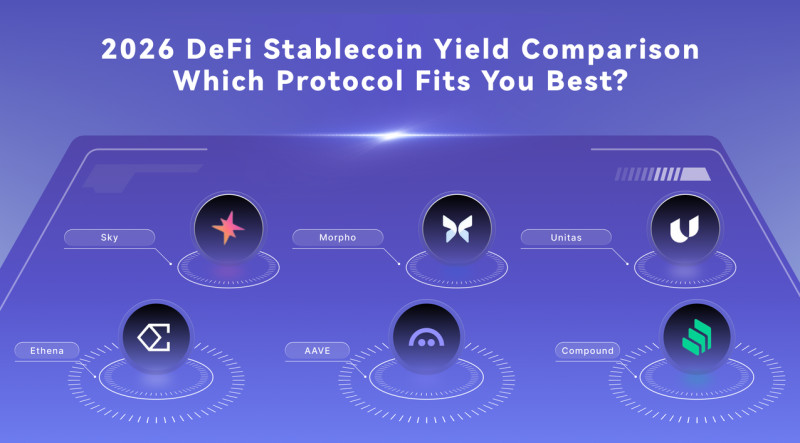
Morpho overtook Compound as a large lending protocol by using curator-managed vaults. These pay a premium over Aave base rate. Vault shares go up as interest accrues, with auto-compounding. Sky issues USDS and pays from protocol surplus and real-world asset yields. BenPay indicative rates show Sol USD near 13.06%, Aave around 3.38%, Compound 3.65%, Morpho 4.13%, Sky 4%, Ethena 4.36%.
Aave and Compound in Plain Terms
Aave is the deepest liquidity pool. You can withdraw instantly when pool has funds, with slight delay if usage is extreme. Borrowers lock ETH or SOL as overcollateral. A safety module with staked AAVE acts as insurance. Normal conditions show typical yields 2.5% to 3.6% on USDT/USDC, but high demand can spike them short term.
Compound redesigned around single-borrow-asset markets to limit contagion. It had no solvency events since launch. The compound crypto price for cUSDC rises over time as it represents principal plus yield. Occasionally COMP token incentives boosted yields. It usually sits 50 to 100 basis points lower than Aave. Aave has isolated mode to quarantine long-tail collateral.
Morpho and Sky Savings Rate
Morpho Blue vaults run by curators like Gauntlet and Steakhouse. They isolate markets with specific collateral rules. Depositors earn spread between market borrow rate and Aave base rate, about 50 to 150 basis points premium. Instant redemption when vault has liquidity.
Sky, formerly MakerDAO, offers the Sky Savings Rate (SSR). It pays from lending fees and US Treasuries backing. No borrower counterparty, but you face Sky governance and USDC peg pass-through risk. sUSDS is an accumulating certificate, no lock-up, redeem anytime. Spark provides direct Sky Savings Rate exposure at same 4-4.5% APY.
Specialized High-Yield Stablecoins
Some newer coins promise much higher returns. Unitas on Solana uses delta-neutral trades, yielding around 13% from trading fees and funding rates. Ethena's USDe captures perpetual funding, around 4-10% with 10-day redemption. Before touching these, check the usd1 stablecoin price to see how pegs behave in stress.
Specialized yield coins
- Unitas (USDu): strategy-based, overcollateralized 130-200%, ~13% APY
- Ethena (USDe): synthetic dollar, medium risk, ~4-10% APY
- thUSD: gold-backed yield-bearing, launched with $100M pre-deposit, ~8% APR
- sUSD: Synthetix stable, used in perps, had depeg below $0.70, rebuilding
thUSD is built on tokenized gold (thGOLD) and uses delta-neutral minting. It paid average 8.27% APR in its early internal results, positive every month. sUSD had a rough patch but Synthetix supports it with buybacks and a meta-basis vault plan. Unitas keeps overcollateralized reserves and permissionless redemption. Ethena yield drops when funding rates go negative.
Algorithmic Stablecoins and Big APY
Algorithmic coins have led charts for highest yield offerings. TRON's USDD launched April 2022 boasting 40% APR at the time. USN on Near offered min 11% APY, first lenders 20%. Terra USD via Anchor paid 20% before its May 2022 collapse. These numbers look sweet but hide weak spots.
High APYs often reflect higher risk, weaker collateral, or lockups/incentives.
After UST fell, doubts rose about algorithmic models. Instant withdrawals allowed runs. High yields often come from token incentives or shaky collateral. I'd say pay attention to what backs the coin, not just the percent. USN yield later changed with market value of tokens and NEAR staking percentage.
Risk-Tier Framework for Yields
To sort the mess, a tier system helps. Tier 1 is low risk, 3.5-4.5% APY, like Aave USDC base or Sky SSR. Tier 2 is diversified protocol, 4.5-7% APY, like Morpho blue-chip vaults. Tier 3 specialized, 7-12% APY, more risk. Tier 4 structural risk, 12%+ APY, degen vaults.
Yield risk tiers
- Tier 1: sovereign-equivalent, 3.5-4.5% APY, low custody/peg/smart-contract risk
- Tier 2: diversified protocol, 4.5-7% APY, medium smart-contract risk
- Tier 3: specialized/leveraged, 7-12% APY, high smart-contract risk
- Tier 4: structural risk, 12%+ APY, high custody/peg/smart-contract risk
Most treasuries stay above Tier 2. DeFi-native funds can size Tier 3. Tier 4 is compensation for known risk, so position-size small. Hey, don't skip this part: match your risk mood to the tier before chasing highest stablecoin yields. And remember that a flashy APY number can hide a weak peg.
What to Check Before You Commit
I always look at how the platform makes yield. Is it overcollateralised lending, liquidity provision, or complex loops? Transparency matters: published reports of assets and liabilities. Withdrawal reliability is as key as yield itself. And think about taxes and crypto trading rules where you live.
Checklist before deposit
- How yield is generated: lending, fees, incentives
- Transparency: attestations, published reports
- Withdrawal mechanics: instant or locked, redemption delays
- Collateral model: overcollateralised reduces but not removes risk
- Consistency: steady returns beat short-term spikes
User type matters. Conservative folks do well with Sky, Morpho, Aave, Compound. Those okay with market swings might try Unitas. If you tolerate sentiment risk for highest returns, Ethena is an option. Chain choice also plays: Base often pays 50-100 bps higher than Ethereum mainnet for USDC supply. Cross-chain routing via intent-based orchestrators collapses withdraw/bridge/deposit into one step.
Lazy Summer and Yield Aggregators
Yield aggregators simplify life. Lazy Summer Protocol auto-allocates to quality sources via one interface. It rotates between concentration and diversification based on market. Examples show Origin WETH avg 10.53% TVL at peak, Morpho Gauntlet WETH avg 9.22%, and tactical shifts to SkyUsds or AaveV3 during stress.
The protocol launched with 12 sources and later broadened to 40, then tightened to 5 after a crisis. Its token SUMR lets depositors earn extra. For a passive holder, an aggregator can cut ops work while still catching decent yield. New sources reviewed include Midas Apollo Crypto and Reserve ETH+. The lesson is that active rotation can guard against downside.
Future of Stablecoin Yield
The trend moves toward structured products and clear risk management. Less focus on chasing highest stablecoin yields, more on understanding yield production. Rules from policymakers are evolving, and institutional money grows. That may steady markets but shrink extreme yield gaps over time.
Aggregation tools like Lazy Summer show adaptive strategy. More protocols may copy this. I think the calm approach wins: pick tier-appropriate yields, watch peg and custody, and sleep well. That's the simple breakdown I wanted to share. You don't need to be a DeFi guru to earn decent yield, just a clear eye on what sits behind the number.



Comments on “Where to Find the Highest Stablecoin Yields and What to Keep an Eye On”
No comments yet. Be the first to share your thoughts.