
Crypto Tax Reporting Threshold: What It Really Means For Everyday Investors

What The Crypto Tax Reporting Threshold Actually Means
Hey, let's talk about the crypto tax reporting threshold in plain words. If you trade crypto, you, probably, already heard that exchanges send forms to the IRS after you cross some limit. The truth is, the federal broker rule says platforms must report deals above $10. That tiny crypto tax reporting threshold comes from old rules for stocks and such. It means even a small buy or sell can spark a form.
But here is the thing. The limit is for the exchange's duty to send a form, not for your duty to pay tax. Under taxes and crypto trading every taxable event counts no matter how small. I think that confuses a lot of folks. The crypto tax reporting threshold just sets when brokers file papers, not when you owe money.
Kraken's Big Form Filing Example
I read a public post from Kraken where they shared real numbers. They filed 56 million Form 1099-DA with the IRS for one tax year. Most of those forms covered amounts under $50. The exchange used this to tell Congress the $10 minimum reporting limit is too low. They said the vast majority of these forms represent deals so small they would never trigger reports in normal markets.
"The vast majority of these forms represent transactions so small they would never trigger reporting requirements in traditional markets," Kraken said in its post.
Breakdown from their data: about 18.5 million forms were for deals under $1. Over half were $10 or less. Only 8.5% cleared $600, which is the mark for non-employee pay reports. Each form also goes to the customer and makes a task for the taxpayer. Standard tax software does not handle crypto well. Kraken guessed the extra burden on an active holder at $250 to $500 a year for special software.

Why The Ten Dollar Limit Causes Trouble
The crypto tax reporting threshold of $10 was pulled from rules for traditional finance. Crypto platforms must report transactions above that amount. Kraken argues this creates millions of low-value filings that add cost without real tax revenue. I agree it sounds like a lot of paper for penny deals.
Problems with a low limit
- Millions of forms for tiny deals under $1 flood the system.
- Taxpayers get forms they must reconcile by hand.
- Standard tax software fails to handle crypto transactions.
- Extra cost for dedicated crypto tax tools falls on regular people.
Kraken said the hours spent reconciling micro-deals with incomplete data create costs way out of line with any tax collected. The National Taxpayers Union Foundation puts average time for non-business filers at about 13 hours and $290 per return. That's before crypto extra work.
Form 1099-DA Basics
The new form at the heart of IRS crypto currency reporting is called Form 1099-DA. It stands for Digital Asset Proceeds From Broker Transactions. This is a statement your broker sends you and the IRS. You do not fill it out. It shows gross proceeds from sales or exchanges of digital assets on a US centralized exchange.
It came from a 2021 infrastructure bill where Congress said crypto needs the same reporting as stocks. For the first filing season, brokers report only what you sold for, not what you paid. Cost basis becomes required starting the next year. So the form is incomplete by design at first.
Form 1099-DA is described as a speed camera that catches every car on the highway but reads half the license plates wrong.

What The Form Reports And What It Skips
In the first year, the crypto tax reporting threshold for brokers means they send Form 1099-DA when they facilitate a sale, but the form only lists gross proceeds. It does not calculate your tax. It does not replace Form 8949. It also does not capture crypto income like staking rewards or interest; that goes on other forms.
Typically on Form 1099-DA
- Crypto sold for USD or other fiat.
- Crypto-to-crypto trades on a centralized platform.
- Your name, address, and tax ID number.
- The digital asset name and transaction date and time.
Typically not on Form 1099-DA
- Staking rewards and airdrops, sent on Form 1099-MISC.
- Interest or yield from lending or DeFi protocols.
- Wrapping or unwrapping like ETH to WETH, deferred by IRS notice.
- On-chain DeFi activity and non-custodial wallet trades.
Just because it's not on the form doesn't mean it's tax free. You must still report all taxable activity. The crypto tax reporting threshold only governs broker paperwork, not your full tax duty.
Stablecoin Special Rules
The IRS lets brokers use an optional method for certain stablecoin deals. Instead of listing each sale, they may combine all of a customer's designated sales for one qualifying stablecoin and report totals on one form. This optional aggregate method uses a $10,000 total designated sales threshold per year before separate forms are required for each stablecoin.
Examples of stablecoin thresholds
- Total designated sales below $10,000: no form needed under optional method, but still taxable.
- Total above $10,000: broker must issue separate forms for each qualifying stablecoin sold.
- Stablecoin swapped for Bitcoin or ETH: not a designated sale, not reported under this method.
- Qualifying stablecoin must mirror a fiat price and have a redemption pledge.
A stablecoin is qualifying only if it holds a one-to-one peg, has a stable mechanism, and is accepted as payment. USDC and USDT likely fit. Algorithmic ones may not. This is a rare case where a higher crypto tax reporting threshold applies for brokers, but you still report gains.
The Zero Cost Basis Problem
At a tax shop called CountDeFi, they say the biggest issue is zero cost basis on forms. Your Form 1099-DA shows what you sold for, but often shows zero for what you paid. If you ever moved crypto between platforms, the basis trail breaks. The IRS sees full proceeds as gain if you don't fix it.
"The hours taxpayers spend reconciling these micro-transactions, often with incomplete data, generate costs wildly disproportionate to any revenue the IRS will collect from them," Kraken said.
You are allowed and expected to report your own cost basis on Form 8949. Missing basis does not mean taxable gain. The IRS confirmed this in a notice. You need your own records to be right. Blindly importing the form without correction likely means overpaying.
Wallet-By-Wallet Method
Starting from January 1 of the first reporting year, taxpayers must use the wallet-by-wallet cost basis method. This replaces the old universal method. Each wallet or exchange account is its own pool for gain/loss math. You can't lump all your Bitcoin across wallets together.
Transition checklist
- Identify all wallets and exchange accounts used through prior year.
- Assign each wallet its own cost-basis record.
- Verify historical data and reconcile transfers between wallets.
- Adopt the new method and keep transition docs audit-ready.
Failing to transition properly could cause basis mess and raise audit risk. This aligns with how brokers will later report basis. I'd say get this right early.
Filing With Form 8949 And Schedule D
When you actually do your return, you use Form 8949 to list each sale. Schedule D sums it up. This is core to how you report crypto on taxes for capital gains. Step one is gather all transaction data from exchanges and DeFi.
Steps to file
- Step 1: Gather buys, sells, swaps, and crypto income records.
- Step 2: Fill Form 8949 short-term and long-term parts with box choices.
- Step 3: Move totals to Schedule D and calculate net gains.
- Step 4: Add Schedule 1 for staking, mining, airdrops ordinary income.
For each transaction you need asset name, dates, proceeds, and cost basis. Crypto tax software can help aggregate across platforms. But remember the exchange form may not show basis. You fill the gap.
IRS Matching And Audit Risk
Form 1099-DA gives the IRS direct data from every major US exchange. Before this, crypto was a blind spot. Tax gap research shows compliance drops near 55% without third-party reporting, but exceeds 90% with it. Now the IRS has receipts.
"The biggest mistake I see is investors who assume their exchange handles everything. Your exchange reports what it knows, but only you have the full picture across all platforms, wallets, and DeFi activity." -- Nick Slettengren, CountOnSheep
Automated systems scan your Form 8949 against the 1099-DA. If numbers differ, you may get a CP2000 notice. Reconcile both ways: match reported proceeds and include what the form left out. Most software doesn't do this alone.
International Reporting Thresholds
Beyond US rules, global frameworks like CRS 2.0 and CARF change crypto currency IRS style reporting abroad. Many countries committed to new data swaps. For pre-existing entity accounts, a $50,000 threshold often applies. For new accounts, many go zero-threshold for non-residents.

Stablecoins and central bank digital coins are explicitly included. Platforms must report gross proceeds from sale to fiat. Non-custodial wallets aren't directly covered, but any touch with a regulated on-ramp triggers a reportable event. The crypto tax reporting threshold varies by border, but the push is for more visibility.
State Tax Example Washington
Some US states add their own layer. Washington has a 9.9% income tax on capital gains and crypto income above $1 million adjusted gross income. It starts from federal AGI. If IRS adjusts your AGI from a 1099-DA, the state can follow. This shows how the crypto tax reporting threshold at federal level ripples down.
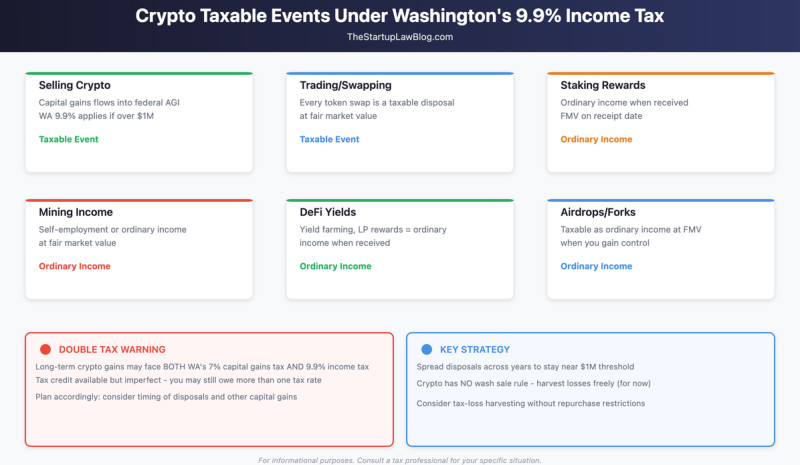
Washington also has a separate capital gains tax with its own brackets. Long-term gains aren't double taxed, but short-term gains and ordinary crypto income face the 9.9% over $1M. Timing of big trades matters. Spread sales across years if you can.
How You Report Crypto On Taxes
Let's get practical about how you report crypto on taxes . You file Form 8949 and Schedule D for trades. Staking and airdrops go on Schedule 1 or 1099-MISC. Mining may need Schedule C. Even if you don't get a form, you must report everything.
Common crypto tax forms
- Selling or swapping crypto: Form 1099-DA, no threshold, capital gains.
- Staking rewards, airdrops: Form 1099-MISC, threshold $600, ordinary income.
- Interest or yield: Form 1099-INT or MISC, ordinary income.
- Mining hobby: self-report on Schedule 1, no broker form.
The crypto tax reporting threshold for brokers does not create a minimum for your reporting. Every taxable event counts. I'd keep good records all year. Also, IRS crypto currency reporting now means they see exchanges' data, so match your numbers.
Tools And Software Help
I won't pretend doing this by hand is fun. Many people look for some free crypto tax software that's decent or a solid crypto tax tool to sort trades. Names like CoinTracker, Koinly, CoinTracking get mentioned. These can aggregate wallets and make Form 8949.
Helpful software types
- good cryptocurrency tax software that pulls exchange data.
- a crypto capital gains tax calculator for quick gain estimates.
- Tools that handle wallet-by-wallet basis tracking.
- Software that flags 1099-DA mismatches before filing.
Even with good cryptocurrency tax software , you must check cost basis yourself. The form may show zero. A crypto capital gains tax calculator helps but can't replace your records. And hey, don't skip this part: reconcile before April deadline.

Small Transactions Still Count
This is the key point about the crypto tax reporting threshold. Just because your broker doesn't send a form for a tiny deal doesn't mean it's free of tax. Kraken gave an example: pay for a $7.99 meal with Bitcoin through a payment app, you triggered a taxable event. You must look up cost basis of that fraction and report gain or loss on Form 8949.
"Imagine you walk into a Steak 'n Shake and pay for a $7.99 meal with Bitcoin through a payment app. You have triggered a taxable event."
Cato Institute said buying a cup of coffee daily with BTC could lead to over 100 pages of filings. That's wild. So the threshold for forms is not the threshold for tax. Small deals still count as taxable income. Knowing the limit helps you stay compliant without over-reporting every penny, but underreporting risks notices.
What I'd Watch For
Look, I care about folks not getting burned. The crypto tax reporting threshold debate is real, but for you the safe path is simple: track every trade, every staking reward, every swap. Use the a decent crypto tax tool you can find if needed. And watch for phantom income on staked tokens you haven't sold.
Kraken calls current staking tax treatment phantom income because you owe tax on tokens at receipt value even if price later falls. That can hurt. Congress may change rules, but until then, report at receipt as ordinary income. I'd also note stolen crypto taxes and crypto taxes in Canada are separate topics I won't dive into here, but the same care applies.
Hey, don't skip this part: the broker deadline for forms may get relief in rollout years, but your filing deadline does not move. The crypto tax reporting threshold might shift someday, yet your duty to report taxable events stays. Keep your records tight and you'll be fine.




Comments on “Crypto Tax Reporting Threshold: What It Really Means For Everyday Investors”
No comments yet. Be the first to share your thoughts.